Introduction: A Growing Health Concern in North and Western India
Kidney stones — or renal calculi — have quietly become one of the most common urological problems across India. But what’s striking is that this problem isn’t evenly spread. Regions like Rajasthan, Gujarat, Punjab, Haryana, Madhya Pradesh, and parts of Delhi consistently show a much higher prevalence of kidney stones compared to other areas.
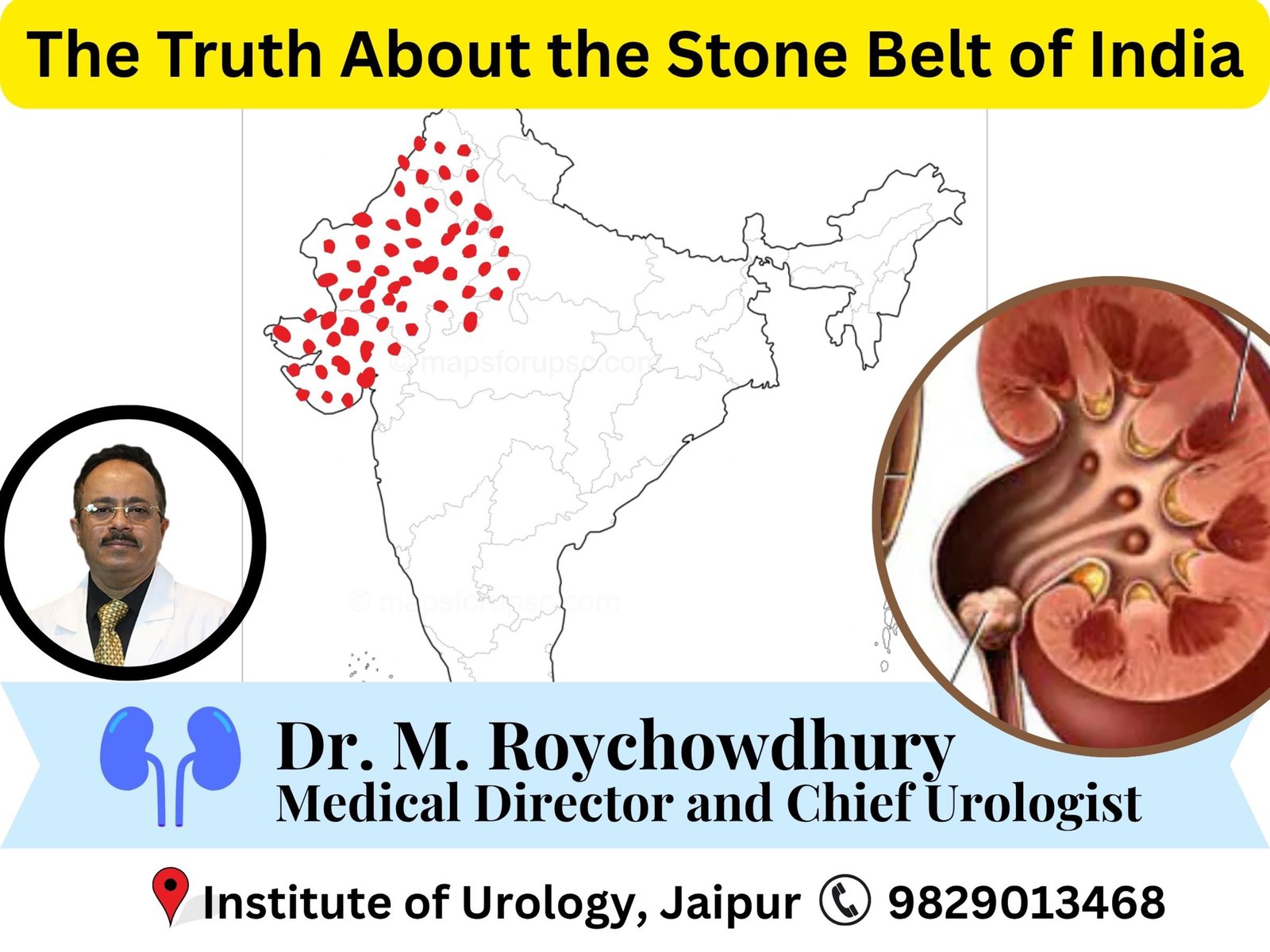
This phenomenon has led doctors to label this area the “Stone Belt of India.” But what exactly makes this part of the country so prone to stones? Is it the climate, the water, or our dietary habits? Let’s break down the science and the lifestyle factors that together form the perfect storm for kidney stone formation — and understand what can be done to prevent it.
🌞 The Stone Belt of India – A Unique Geographical Reality
Several Indian studies, including those published in the Indian Journal of Urology and National Journal of Community Medicine, have consistently highlighted a cluster of high stone incidence across North and Western India — particularly Rajasthan, Gujarat, Punjab, Haryana, an parts of Madhya Pradesh.
Why This Region?
These states share a combination of:
- Arid to semi-arid climate
- High ambient temperatures
- Low water intake and dehydration
- Hard water with high mineral content
- Dietary patterns rich in oxalate, sodium, and animal protein
Together, these factors increase urinary concentration and alter the balance of stone-forming substances in urine.
A study published in the Indian Journal of Urology (IJU, 2018) noted that these states contribute to nearly one-third of all kidney stone cases reported across the country. Rajasthan alone accounts for a disproportionately high percentage, especially in districts like Jaipur, Jodhpur, Bikaner, and Udaipur, where urology centers report thousands of cases each year.
💧 Dehydration – The Leading Culprit in Desert Regions
The single most important factor explaining the high incidence of kidney stones in these states is chronic dehydration.
Rajasthan and Gujarat experience extreme temperatures during most of the year, with summer temperatures exceeding 45°C in many districts. In such conditions, there is excessive fluid loss through sweat and respiration, often without adequate replenishment.
- Low water intake results in highly concentrated urine.
- Concentrated urine means higher mineral saturation—especially of calcium, oxalate,
uric acid, and phosphate, which are the primary constituents of most stones. - Over time, these crystals stick together to form stones.
According to a study published in The Lancet Regional Health – Southeast Asia (2022), residents of semi-arid and desert zones are 2.5 times more likely to develop kidney stones compared to those in humid coastal areas.
In short:
The less you drink, the more your kidneys struggle to flush out waste—creating the perfect storm for stone formation.
🧂 High Mineral Content in Groundwater – The Hidden Enemy
Another striking feature of the Stone Belt is the high mineral content in drinking water.
Groundwater in Rajasthan, Gujarat, and Punjab often contains excessive calcium, magnesium, fluoride, and total dissolved solids (TDS).
A study conducted by the Central Ground Water Board (CGWB, 2019) revealed that
groundwater in parts of western Rajasthan has calcium concentrations exceeding 200 mg/L— double the safe limit recommended by the WHO. This “hard water” leads to increased calcium excretion through urine, which then binds with oxalate or phosphate to form calcium-based kidney stones.
Hard water = High calcium load → Greater stone formation risk.
🍲 Dietary Habits – Rich Food, Poor Hydration
Diet plays an important role in stone formation, and traditional diets of North and Western India may contribute to the risk.
Common Dietary Patterns in the Stone Belt:
- High salt intake:
Excessive salt increases calcium excretion in urine (hypercalciuria), making stone
formation more likely.
Example: Pickles, papads, salted snacks, and processed foods. - Low fluid and fruit intake:
Due to harsh climate and lifestyle habits, people tend to drink less water and consume fewer citrus fruits, which normally prevent stone formation. - High animal protein diet:
Diets rich in meat, paneer, and pulses increase uric acid levels—leading to uric acid
stones, which are common in these regions. - Low citrate levels:
Citrate, found in lemon, amla, and citrus fruits, naturally inhibits stone formation. Low intake of these foods removes a key protective factor.
🧬 Genetic Predisposition and Family History
Studies have shown that kidney stones often run in families. Genetic predisposition affects the way kidneys handle calcium and oxalate.
According to a study in the Journal of Urology (2019), people with a first-degree relative having kidney stones have a 2.4 times higher risk of developing them themselves.
In the Stone Belt, where both environmental and genetic risks coexist, this creates a vicious cycle—families passing both genes and dietary patterns through generations.
🏜 Environmental and Occupational Risks
Many residents of Rajasthan and Gujarat work outdoors in agriculture, construction, or
mining, often under intense sunlight and without regular access to water.
- High perspiration without hydration = low urine volume.
- Occupational exposure to heat and dust also increases dehydration risk.
In a study from Urology Annals (2020), workers exposed to high temperatures (≥38°C) for more than 6 hours daily were found to have double the incidence of kidney stones compared to office workers in the same region.
🌾 Socioeconomic and Lifestyle Factors
- Limited awareness: Many rural populations don’t recognize early symptoms like flank pain or burning urination.
- Self-medication and delayed care: Painkillers or home remedies are often used before consulting a urologist.
- Sedentary lifestyle and obesity: Rising urbanization has led to less physical activity and metabolic changes, contributing to higher uric acid and calcium levels.
🧠 Medical Insight: What Actually Happens Inside the Kidney
The formation of a kidney stone is a complex biochemical process.
It begins when urine becomes supersaturated with minerals like calcium, oxalate, or uric acid. When these concentrations exceed solubility limits, crystals start to form. Over time, they combine to form solid concretions.
Key mechanisms:
- Reduced urine volume → increased concentration of stone-forming salts.
- Deficiency of inhibitors (like citrate, magnesium).
- Presence of infection → contributes to struvite stones.
According to Pak et al. (NEJM, 2016), maintaining adequate hydration and normal urine pH remains the most effective preventive strategy.
🍋 Can Kidney Stones Be Prevented?
Absolutely. Prevention is possible through small, consistent lifestyle changes:
- Hydration is key: Drink at least 2.5–3 liters of water per day.
In hot climates like Rajasthan and Gujarat, increase this to 3.5 liters. - Avoid excessive salt and processed food.
- Limit oxalate-rich foods such as spinach, nuts, and tea.
- Add lemon juice or citrus fruits daily—these boost urinary citrate, a natural stone
inhibitor. - Regular check-ups and urine analysis if you have a family history.
- Physical activity: Helps reduce urinary stasis and promotes kidney function.
🔬 Latest Advances in Kidney Stone Management
Modern urology has transformed the treatment of kidney stones from painful open surgeries to minimally invasive procedures with faster recovery and minimal discomfort.
Key Modalities Include:
- RIRS (Retrograde Intrarenal Surgery):
A flexible laser-based endoscopic technique for removing stones from inside the kidney. - PCNL (Percutaneous Nephrolithotomy):
Ideal for larger stones; involves making a small tract into the kidney to remove stones
directly. - ESWL (Extracorporeal Shock Wave Lithotripsy):
Non-invasive treatment using focused shock waves to break stones. - Laser Lithotripsy:
Uses a Holmium:YAG laser to fragment stones precisely with minimal injury to
surrounding tissues.
Modern facilities like the Institute of Urology, Jaipur, are fully equipped with state-of-the-art laser technologies, ensuring the highest success rates and patient comfort.
🏥 Why the Institute of Urology, Jaipur, Stands Out
When it comes to kidney stones and other urological conditions, Dr. M. Roychowdhury and Dr. Rajan Bansal have established themselves as pioneers in minimally invasive and laser-based urological surgery.
Their expertise spans across:
- Kidney Stone Management (RIRS, PCNL, All advanced Laser Urological Procedures)
- Laser Treatment for Prostate and Urethral Stricture
- Pediatric Urological Surgeries
- Reconstructive Urology and Urethroplasty
The Institute of Urology, Jaipur, is one of India’s most advanced centers where diagnosis, consultation, investigation, and surgery are all available under one roof.
With the latest imaging systems, high-precision lasers, and a compassionate medical team, the Institute has become a referral center for complex kidney and urinary tract cases not just from Rajasthan but across North and Western India.
🌟 Conclusion: The Way Forward with India’s Leading Kidney Stone Treatment Centre – Institute of Urology, Jaipur, Rajasthan
The Stone Belt of India—covering Rajasthan, Gujarat, and Punjab—is a fascinating yet
concerning example of how climate, environment, diet, and lifestyle can collectively influence human health.
But the good news is: kidney stones are both preventable and treatable. With timely hydration, proper diet, and access to expert medical care, the burden of this condition can be significantly reduced.
Premier institutions like the Institute of Urology, Jaipur, under the expert guidance of Dr. M. Roychowdhury and Dr. Rajan Bansal, are leading the way in modern urology—offering precision-based laser treatments, comprehensive diagnostic facilities, and holistic patient care for all urological problems, from stones to prostate to pediatric urology.
If you or someone you know suffers from recurrent kidney stones, early consultation with a qualified urologist can make all the difference.
Because when it comes to kidney health, prevention and expert treatment go hand in hand.
🔖 References
- Indian Journal of Urology, 2018; Vol 34(2): “Regional Trends in Urolithiasis in India.”
- The Lancet Regional Health – Southeast Asia, 2022: “Geographical Correlation of
Climate and Nephrolithiasis.” - Central Ground Water Board (CGWB) Report, 2019: “Assessment of Hardness and TDS
in Western India.” - Urology Annals, 2020; Vol 12(3): “Occupational Heat Stress and Kidney Stone Risk.”
- Pak CYC, NEJM 2016; 374(12): “Pathogenesis and Prevention of Kidney Stones.”