How We Approach Enlarged Prostate at Institute of Urology, Jaipur
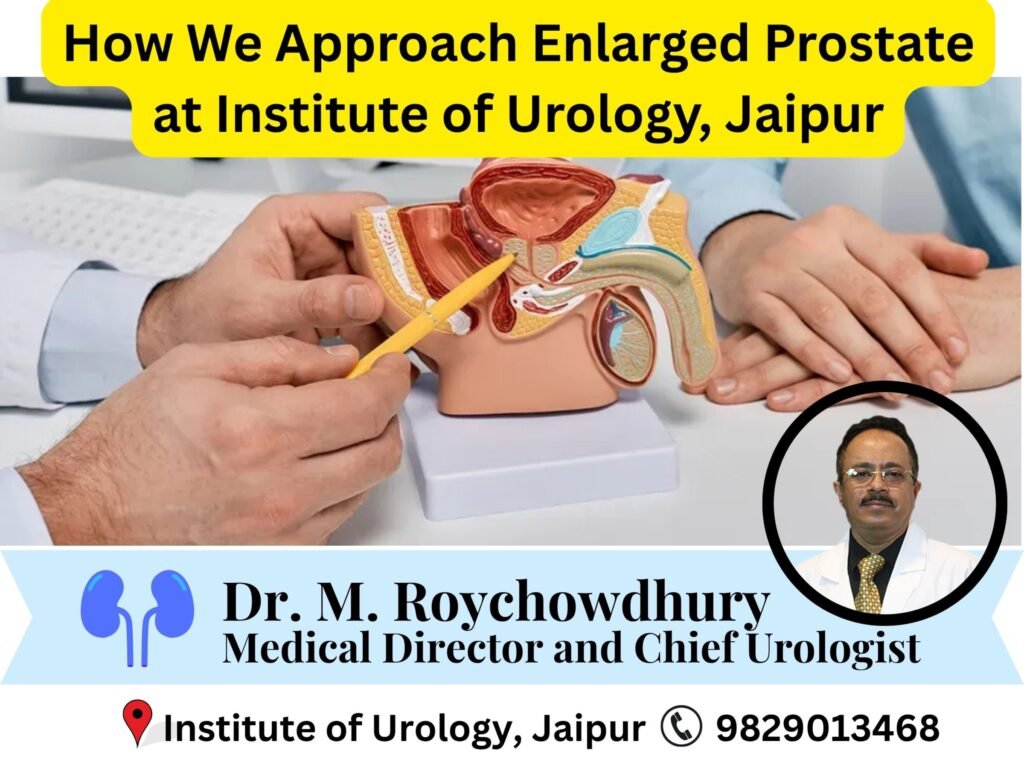
1. Understanding the Prostate and ‘Enlarged Prostate’
The prostate is a small, walnut-shaped gland below the bladder, surrounding the urethra. Its role is to produce seminal fluid. As men age, especially after 40, the prostate can grow, causing Benign Prostatic Hyperplasia (BPH)—a non-cancerous enlargement of the prostate gland. Histological studies show BPH is present in 50–60% of men in their 60s, increasing to 80–90% by their 70s.
This enlargement is driven by proliferation of smooth muscle and epithelial cells in the transition zone. Over time, the advancing prostate may obstruct urine flow, producing bothersome lower urinary tract symptoms (LUTS) such as:
- Urinary frequency and urgency
- Weak stream, straining or dribbling
- Nocturia (night-time urination)
- Incomplete emptying sensation
The term “enlarged prostate” often refers to prostatic enlargement (BPE), which may precede or accompany bladder outlet obstruction (BOO) from BPH. Distinguishing enlargement, obstruction, and symptoms is essential for personalized management.
2. Why It Matters: Symptoms, Complications & Impact on Quality of Life
2.1 Lower Urinary Tract Symptoms (LUTS)
Symptoms are categorized into:
- Storage: frequency, urgency, nocturia
- Voiding: weak stream, intermittency, straining
- Post-micturition: dribbling, incomplete emptying
Symptoms worsen with time in 20–30% of men over 60 years.
2.2 Complications of Untreated Enlargement
- Acute urinary retention
- Recurrent UTIs, bladder stones
- Hydronephrosis, renal impairment
- Impact on daily quality of life and mental well-being
2.3 Quality of Life
When symptoms interfere with sleep, work, or intimacy, proactive evaluation and treatment are warranted.
3. Diagnosis: Evaluation at Institute of Urology, Jaipur
Our approach integrates clinical evaluation with targeted diagnostics:
3.1 Detailed History
- Symptom scoring using IPSS (International Prostate Symptom Score)
- Onset, progression, voiding vs storage patterns
- Medical history: comorbidities, medications, sexual function
- Prior UTIs, hematuria, urinary retention
3.2 Physical Examination
- Digital rectal exam (DRE) to assess prostate size, consistency, nodules
3.3 Laboratory Tests
- Urine analysis to rule out infection or hematuria
- PSA (Prostate-Specific Antigen) if clinically indicated, to assess cancer risk
3.4 Imaging & Advanced Diagnostics
- Ultrasound: prostate volume, postvoid residual, upper tract
- Uroflowmetry: measures peak urine flow
- Optional MAU test with blood work depending on the case
4. Management Approach: Medical & Surgical Strategies
4.1 Medical Management
Widely supported as first-line therapy:
- Alpha‑blockers (tamsulosin, silodosin): relax smooth muscle, improve flow
- 5‑alpha-reductase inhibitors (finasteride, dutasteride): shrink prostate by ~25% over 6–12 months
- Combination therapy shows better improvement and prevents progression
- PDE-5 inhibitors (tadalafil) help with both LUTS and erectile dysfunction
4.2 Lifestyle Modifications
Supportive measures backed by evidence:
- Limit evening fluids, caffeine, alcohol
- Bladder training and double-voiding
- Pelvic floor exercises
- Healthy weight maintenance
4.3 Minimally Invasive Surgical Techniques (MISTs)
For moderate to severe LUTS or complications:
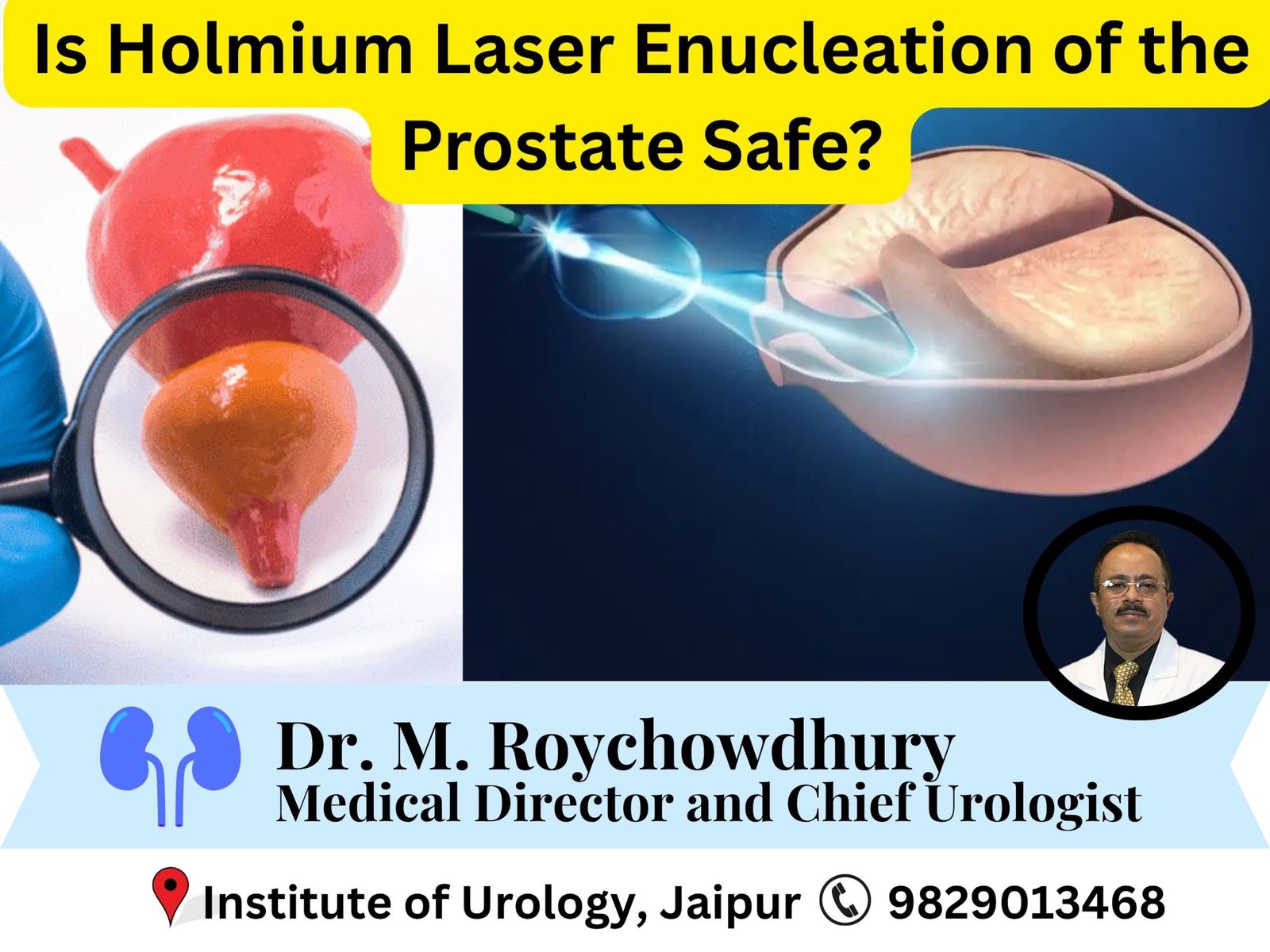
- HoLEP (Holmium Laser Enucleation) – Gold standard endoscopic procedure; Dr. Roychowdhury’s team practices this widely
- PVP (GreenLight Laser Vaporization)
- Urolift, Rezūm (water vapor therapy), TUMT and TUNA
- Aquablation – robotic water-jet therapy with reduced sexual side effects
- Prostatic Artery Embolization (PAE) – emerging non-surgical modality for larger prostates
4.4 Traditional Surgery
- TURP (Transurethral Resection) – effective with an 80–90% symptom improvement but higher risks of bleeding and sexual side effects
5. AUA 2023 Guidelines & Personalized Care
According to AUA guidelines:
- Start with shared decision-making, considering patient preference and symptom severity
- Medical therapy is recommended for moderate to severe LUTS
- MISTs or surgery are advised for complications or inadequate response to meds
The approach at Institute of Urology, Jaipur reflects this algorithm—tailored to each patient’s condition and goals.
6. Patient Journey: What to Expect at IOU, Jaipur
6.1 Initial Consultation
- Complaints assessed, IPSS administered, clinical evaluation, diagnostics prescribed
6.2 Personalized Treatment Planning
- Based on prostate size, symptoms, comorbidities, patient preferences
6.3 Implementation
- Medications, lifestyle support, or advanced procedures performed in-house
- HoLEP is offered under spinal anesthesia with same-day discharge; PVP or Urolift for smaller prostates
6.4 Follow-Up
- Regular monitoring at 7 days, 6 weeks, 3 months, with uroflowmetry and urine tests
- Adjust treatment based on symptom evolution
6.5 Outcome Tracking
- Nationally, IOU reports near 100% satisfaction in stone and prostate disease
- Consistent symptom score improvements and minimal complications
7. Innovations & Emerging Trends
- Robotic MISTs like Aquablation are transforming prostate surgery
- PAE offers a promising non-surgical alternative for refractory cases
- Shared treatment models balance symptoms, prostate size, sexual outcomes, and patient lifestyle
8. Comparative Considerations: Which Treatment Is Right for You?
| Treatment Option | What It Is | Advantages | Limitations |
|---|
| Watchful Waiting / Lifestyle Changes | For mild symptoms; includes dietary changes, reducing caffeine/alcohol, and timed voiding. | No medications or procedures needed. Cost-effective. | May not be effective if symptoms worsen over time. |
| Medications | Includes alpha-blockers (e.g., Tamsulosin) and 5-alpha-reductase inhibitors (e.g., Finasteride). | Non-invasive. Reduces symptoms and prostate size over time. | Side effects include dizziness, fatigue, sexual dysfunction. |
| HoLEP (Holmium Laser Enucleation of the Prostate) | Minimally invasive laser surgery to remove excess prostate tissue. | Suitable for large prostates. Low retreatment rates. Short recovery. | Requires skilled surgeon and laser setup. |
| TURP (Transurethral Resection of the Prostate) | Gold standard surgical treatment; removes part of the prostate using a scope. | High success rate. Long-established method. | Invasive; longer hospital stay and recovery. Risk of bleeding. |
| Open or Robotic Prostatectomy | Surgical removal of the prostate (rarely needed now, reserved for very large glands). | Effective for extremely large prostates or when other methods fail. | Major surgery with longer recovery and higher complication risk. |
9. Case Example from IOU
A 65-year-old male with severe LUTS and a prostate size of 70 mL underwent HoLEP at IOU:
- Same-day discharge
- Symptom score dropped from IPSS 25 to 8 within 6 weeks
- Uroflowmetry improved from 8 to 19 mL/s
- Returned to normal activities; reported higher satisfaction
10. Prevention and Long-Term Outlook
- Routine monitoring for men aged 50+; earlier if symptoms develop
- Encourage exercise, healthy weight, fluid management
- Recognize when to seek specialist care: failure of medications, retention, hematuria, UTIs
Conclusion
An enlarged prostate is more than a normal part of aging—it can impact daily life and health. Early diagnosis and a tailored treatment strategy, balancing lifestyle changes, medications, or minimally invasive and surgical options, can dramatically improve outcomes.
At the Institute of Urology, Jaipur, every patient benefits from a holistic, evidence-based approach. Led by Dr. M. Roychowdhury, an emeritus endourologist with over 30 years of experience, and Dr. Rajan Bansal, recognized for his skill in advanced laser surgery and patient care, IOU offers a full suite of services—from consultations and diagnostics to cutting-edge treatments like advanced HoLEP under one roof. Combining compassionate care, modern infrastructure, and a patient-first philosophy, we deliver the best urological outcomes in Rajasthan.