An elderly male patient recently presented to the Institute of Urology, Jaipur, with a complaint of on and off haematuria (blood in urine) for several weeks. What stood out was the patient’s immediate decision to approach our institution directly—a testimony to the trust and reputation the hospital has earned over decades. His confidence in our diagnostic approach and treatment outcomes laid the foundation for a streamlined and prompt evaluation.
As per hospital protocol, we initiated a highly focused diagnostic workup. A renal and bladder ultrasound (USG) was ordered as the first step. The USG revealed a large exophytic mass lesion in the urinary bladder, suspicious for neoplastic changes. Additional findings included early medical renal disease (MRD) changes in both kidneys. The ultrasound findings warranted further investigation to assess the extent and nature of the bladder mass.
Confirmatory Imaging and Diagnosis:
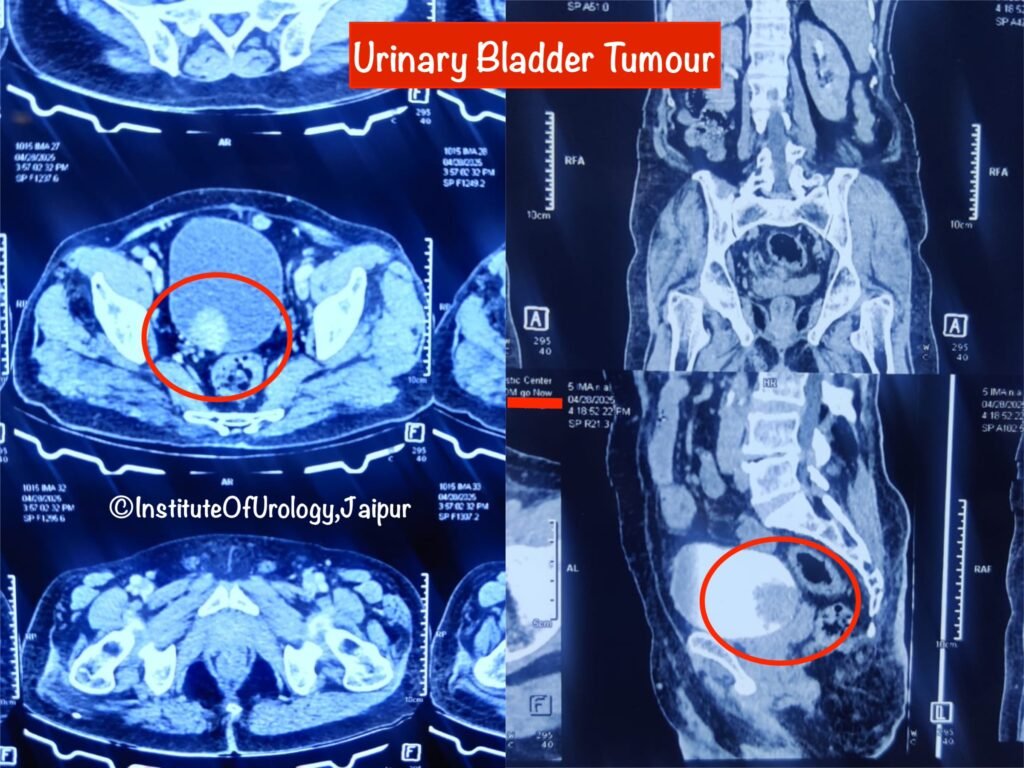
In line with current urological oncology protocols, a contrast-enhanced CT scan of the abdomen and pelvis was performed. The scan confirmed the presence of a large 5 cm exophytic tumor located within the urinary bladder. Fortunately, no signs of metastasis or local spread were seen in this stage, offering a window for organ-sparing intervention.
After thorough counselling and informed discussions with the patient and his family, the decision was made to proceed with a Transurethral Resection of Bladder Tumour (TURBT) – the standard of care for initial management of non-muscle invasive bladder cancer.
Surgical Intervention:
The patient underwent a cystoscopy, which confirmed a large, irregular tumor arising from the lateral bladder wall. During the procedure, a tight anterior urethra was also noted, prompting an Otis urethrotomy for better access and future management. A complete TURBT was performed, and deep muscle biopsies were taken to assess the depth of invasion and tumor grading. The entire surgery was performed under spinal anesthesia (SA) with the patient remaining hemodynamically stable throughout.
Postoperatively, the patient recovered well and was discharged with instructions for follow-up, histopathological review, and further staging if required based on biopsy findings.
Bladder Tumor: Diagnostic and Treatment Protocols
Bladder tumors are typically categorized based on tumor size, number, and depth of muscle invasion. The management protocol is broadly as follows:
- Non-muscle invasive bladder cancer (NMIBC):
- Typically treated with TURBT.
- In high-grade or recurrent cases, intravesical therapy with agents such as BCG (Bacillus Calmette–Guérin) may be initiated.
- Regular surveillance cystoscopy is crucial to monitor for recurrence.
- Muscle-invasive bladder cancer (MIBC):
- Requires more aggressive management, often involving radical cystectomy (bladder removal) and pelvic lymph node dissection, sometimes followed by adjuvant chemotherapy or immunotherapy.
- Select patients may be candidates for bladder-sparing chemoradiotherapy.
- Large tumors (>3–4 cm):
- Though TURBT can still be diagnostic and therapeutic, staging becomes critical.
- Deep biopsies help identify muscle involvement, guiding further treatment strategies.
Reference: Babjuk et al. EAU Guidelines on Non–Muscle-invasive Urothelial Carcinoma of the Bladder, 2022.
Why Institute of Urology, Jaipur Is the First Choice for Urological Cancers:
At the Institute of Urology (IOU), Jaipur, we are proud of our legacy of over 30 years of excellence in managing complex urological conditions, including urological cancers. Our institutional philosophy revolves around comprehensive diagnosis, clear communication with families, and offering best-in-class treatment tailored to individual patients.
While it is universally acknowledged that no cancer treatment can guarantee 100% success, we firmly believe in leaving no stone unturned when it comes to our patients’ care. Our commitment is to apply the latest evidence-based protocols, so patients receive personalized therapy based on the tumor’s nature, stage, and the patient’s overall health status. With our approach, patients are spared the uncertainty of running from hospital to hospital in search of clarity or definitive care.
The Team Behind the Expertise:
The successful management of this case reflects the depth of surgical experience and diagnostic acumen of our lead urologists, Dr. M. Roychowdhury and Dr. Rajan Bansal. Dr. Roychowdhury, with over three decades of dedicated urology practice, brings unparalleled insight into treating urological malignancies. Dr. Bansal complements this legacy with a modern, minimally invasive approach, extensive training, and a strong commitment to precision medicine.
Our facility is equipped with world-class infrastructure, high-resolution imaging technologies, cutting-edge endoscopy and laser equipment, and a highly skilled nursing and support team, allowing us to handle both routine and high-risk cases with consistently excellent outcomes.
Conclusion:
This case illustrates the importance of early and accurate diagnosis, combined with specialist-led surgical management, in achieving the best outcomes for patients with suspected bladder malignancies. At the Institute of Urology, Jaipur, we continue to stand as a beacon of trust, expertise, and ethical medical care for patients across Rajasthan and beyond.
For any symptoms like blood in urine, unexplained flank pain, or urinary complaints, early consultation with an experienced urologist can be life-saving. Our doors remain open for every patient seeking clarity, confidence, and compassionate care.